A Year of Acceleration and Caution
As 2025 comes to a close, the small and midsize business community sits at an interesting crossroads with AI. Across the market, we've seen signs of progress, but also fatigue. Some companies are catching up, others are plateauing, and many are simply overwhelmed.
For most, adoption has happened through the back door: an AI module added to an existing software tool, not a deliberate move to solve a specific business challenge. That kind of convenience adoption feels easy, but it rarely leads to lasting value. The harder and more meaningful work lies in operationalizing AI: implementing it in a way that drives consistent, measurable benefit across the business.
At SkyeStaq, we've found that the biggest misunderstanding among SMBs is viewing AI as a "super-search engine." In reality, it's a set of tools that can transform how problems are defined and solved. The possibilities are here; businesses are simply still figuring them out. Our role is to turn that uncertainty into confidence.

The Reality Check: What SMBs Actually Achieved with AI in 2025
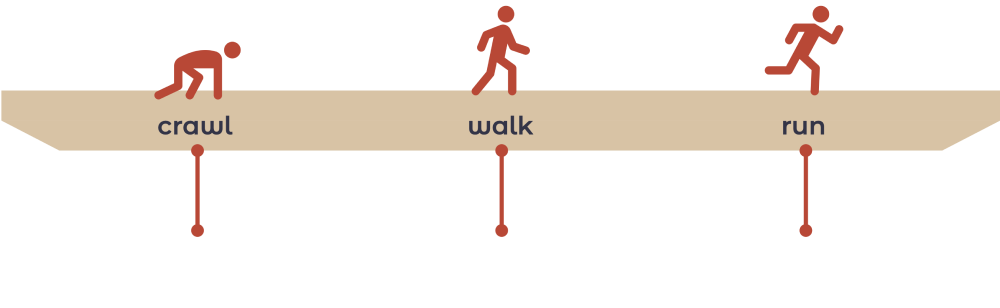
Among the small and midsize businesses that truly saw value from AI this year, one pattern stood out: they started small. Instead of trying to overhaul entire systems or reinvent their operations, these teams took a "crawl–walk–run" approach; layering AI capabilities into their existing workflows a step at a time.
The most common wins have been around time savings. Across the market, small business owners report saving roughly 13 hours a week through AI-enabled automation, and often another 13 hours for their teams [1]. Many companies leaned into AI for content creation, customer communications, or document drafting; areas where automation directly reduces manual workload. How that reclaimed time is used varies: some leaders are trimming costs, while others are finally giving their teams breathing room to focus on higher-value work that had long been deferred.
Measuring ROI remains tricky. The clearest returns are often intangible: lighter workloads, faster turnaround, and people spending more time on judgment and less on repetition. But in a world where overwork is the norm, that's a meaningful form of progress.
The strongest adopters aren't treating AI like a search engine. They're treating it like a team member, learning to give it clear direction, provide context, and use it in partnership. The businesses that do that are the ones quietly turning AI from a curiosity into a capability.
The Hidden Struggles: Why Many Still Feel Stuck
For many small and midsize businesses, the biggest struggle with AI isn't technology; it's focus. Most leaders simply haven't had the time or headspace to define what they actually want AI to do for their organization. Without a clear problem to solve, experimentation drifts into confusion.
Another challenge is the illusion of expertise. Modern AI tools are so easy to chat with that they can create a false sense of capability. Leaders and employees may feel like they're using AI effectively, when in reality, they're only scratching the surface of what's possible. Unlocking real value requires a blend of training, process, and time; three things that are often in short supply.
Concerns around data privacy and security also run deep. Many small businesses remain cautious about how their information is handled once it enters tools like ChatGPT, Claude, or Gemini. That uncertainty often leads to hesitation or fragmented adoption.
And then there's the growing phenomenon of "Shadow AI" (employees using AI tools on their own, outside company oversight). While that can spark innovation, it also introduces risk and inconsistency.
The result is a quiet kind of analysis paralysis: leaders see the potential but feel stuck between enthusiasm and risk. That hesitation often stems from perception, not reality. According to a report by Salesforce, nearly one in three non-users of AI believe fewer than 30 percent of their peers are using it, while about 80 percent of adopters think AI use is already widespread [2]. In other words, many SMBs underestimate just how quickly their peers are moving… and that misconception fuels hesitation even more.
Helping them move from that uncertainty into structured, safe experimentation is exactly where SkyeStaq's work begins.
Lessons for 2026: Three Priorities for SMB Leaders
If 2025 was about testing the tools, 2026 will be about building the foundation to use them well. The small and midsize businesses that make the leap from experimentation to impact will do three things differently.
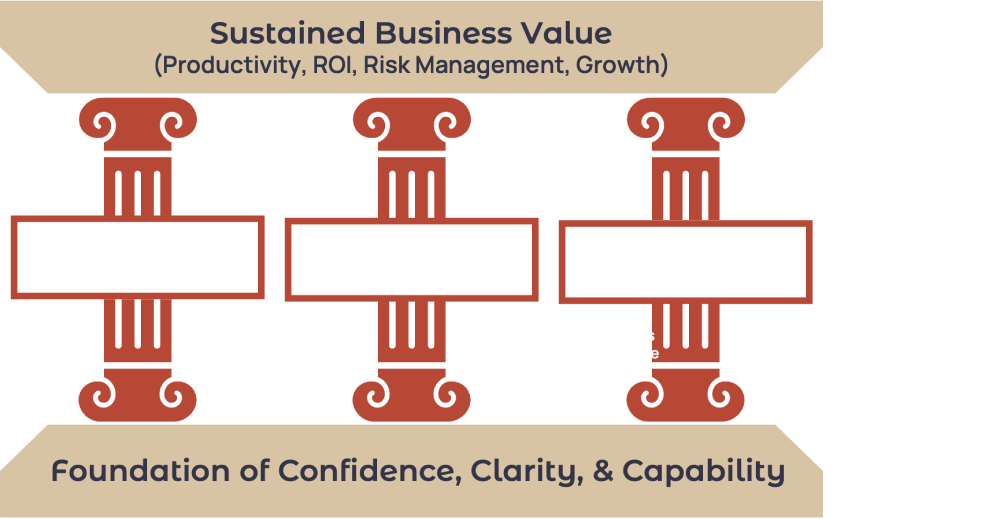
Building lasting success with AI isn't about scale, it's about structure. Governance, enablement, and maturity form the three pillars that keep your business grounded as adoption grows.
1. Build Guardrails: Governance Before Growth
AI's power lies in its flexibility and that's also what makes it unpredictable. The same prompt can yield ten different outputs, so achieving consistency requires oversight. Governance isn't bureaucracy; it's discipline.
For a 40-person company, this simply means two things: keep a human-in-the-loop (HITL) and write things down. Even a brief policy on how and where AI is used sets expectations and reduces risk.
A simple roadmap outlining high-risk areas, such as data handling, content generation, or customer communications provides enough structure to start without slowing momentum. Governance should feel like a seatbelt, not a straitjacket.
2. Focus on Enablement and Everyday Adoption
AI success in small and midsize businesses depends less on what tools you choose and more on how your people use them. The SMB Group's 2025 research found that 68% of SMBs are learning more about AI capabilities in the applications they already use, showing that most leaders understand the value of starting small and building from what's familiar [3].
Before building complex systems, invest in helping teams understand how AI fits into their daily work. Identify simple, repeatable workflows where it can save time or improve quality. The businesses gaining the most traction with AI aren't the ones with the most advanced tools; they're the ones empowering people to use what's already at their fingertips. Start small, learn fast, and build upward from those early wins.
3. Strengthen Digital Maturity Before Customization
Digital maturity is what separates successful AI adoption from frustration. It measures how well your systems, data, and people work together to serve customers without manual workarounds.
Without strong data processes, clear roles, and defined requirements, custom AI projects often collapse under their own weight. Technology vendors can build the tool, but only a thoughtful partner can ensure it fits. Starting with iterative, low-risk pilots builds the organizational muscles needed to pursue larger, more transformative solutions.
What This Means for the SMB Leader
For small business leaders, the most important message right now is that AI isn't plug-and-play. Like any meaningful technology, it demands time to define the vision, align the team, and plan for how new tools will be managed and measured once they're in place.
The mindset shift going into 2026 is simple but powerful: crawl, walk, run. Start small, prove value, and evolve deliberately. Avoid the temptation to "buy an AI solution" before you've defined what success even looks like.
The real opportunity isn't to replace people, it's to relieve them. Most small teams are already stretched thin. Well-implemented AI can remove friction, reduce burnout, and free employees to focus on the work that truly matters.
If there's one piece of advice to begin the year with, it's this: lead with the problem, not the solution. When you can clearly describe the challenges in your business, finding the right AI answer becomes not only easier, but far more likely to succeed.
At SkyeStaq, we help organizations create that clarity and build the confidence to act on it.
Closing Perspective: From Possibility to Practice
As we move into 2026, the businesses that will thrive with AI won't be the ones chasing every new tool, they'll be the ones that can clearly define their challenges, invest the time to address them, and commit to an iterative path of improvement.
The next phase for SMBs is all about operationalization: ensuring the right strategies, processes, and policies are in place to turn potential into performance. That's where SkyeStaq steps in as a trusted advisor and implementation partner helping leaders not only define what AI should do, but also design, deploy, and operationalize the solutions that make it real. Unlike traditional consultants, we bridge the gap between strategy and execution, ensuring every AI initiative moves from concept to measurable impact.
If this article leaves you thinking, "This finally makes sense. I know where to start," or even "I need to take a step back and get help doing this right," then we've done our job. That's exactly where every successful AI journey begins.